Casting on shouldn’t feel impossible. If your machine refuses to cooperate, the culprit may be your yarn weight — not your skills. Learn why terms like “4-ply” can be confusing, how to match yarns to your machine, and simple fixes to avoid frustration.
Why Your Yarn Will Not Cast On
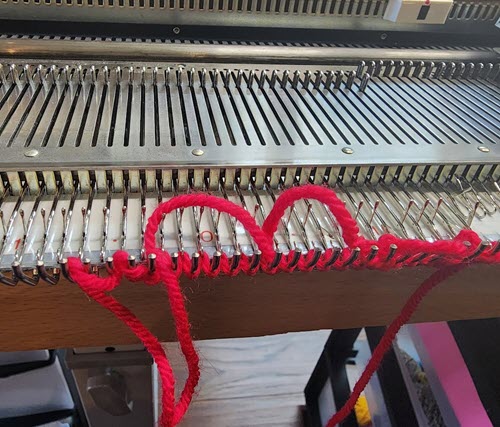
A knitter recently reached out, frustrated because she could not get her stitches cast on. When I asked what yarn she was using, her reply was: "4-ply yarn". Her photo told the story. The yarn was far too heavy for her standard gauge machine. "My manual says to use 4-ply yarn" It was also clear she did not understand what 4-ply meant. The term is confusing. In some parts of the world, ply refers to the number of strands. In others, it is shorthand for a yarn weight category. That means a 4-ply yarn might be fingering weight in the UK while a US knitter could assume it means worsted weight. No wonder she ran into trouble.
Trying to cast on bulky yarn with a standard gauge machine — no wonder the stitches won’t form!
Unlike hand knitting where you can often make a yarn work by changing needle size, machine knitting is picky. Every machine is designed for a specific range of yarn sizes. When you push outside that range, you invite stubborn cast-ons, dropped stitches, and fabric that feels stiff and unwearable.
Machine Gauges and Yarn Weights
Each machine has a comfort zone for yarn. Use this as a quick orientation to understand YOUR machine
Standard gauge 4.5 mm needles
Mid-gauge 6.5 mm needles
Bulky 9 mm needles
If your yarn does not match your machine, it is not your skill. It is a mismatch.
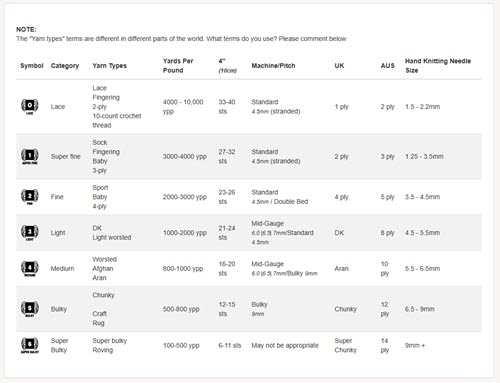
Yarn Weight Reference
Use the chart below to match yarn to machine. Add your common examples and notes so this becomes a go-to reference for you and your readers.
Reminder about ply: 4-ply in the UK usually refers to a light fingering to fingering category. In the US, ply is often used to describe strand count and does not guarantee thickness. When in doubt, check wraps per inch or the yarn label gauge.
When You Love the Wrong Yarn
Do not give up on a beautiful yarn. Try one of these approaches.
Switch machines if you have more than one gauge available
Separate plies to reduce thickness when construction allows
Mix techniques with machine-knit panels and hand-knit sections
Save it for a project where the yarn can shine without a fight
Bottom Line
If casting on feels impossible, pause and check the yarn. Matching yarn weight to machine gauge turns frustration into smooth and satisfying knitting.
NOTE:
The "Yarn types" terms are different in different parts of the world. What terms do you use? Please comment below
What yarn weights work on a standard gauge machine?
Fingering and sport weights (US terms) are the best starting point. Aim for smooth yarns that run freely through the tension mast.
Why did my manual say 4-ply and my yarn still not work?
Ply can mean different things in different regions. Check the actual weight category and wraps per inch rather than strand count or term used.
Can I use worsted weight on a mid-gauge machine?
Sometimes. Light worsted can work with careful tension and a forgiving stitch pattern. Always knit a swatch. Don't tax your LK150 with a yarn that is too heavy or stiff.
How do I test if a yarn will cast on well?
Thread the mast, set a loose tension, and try a simple e-wrap or closed cast on across a small number of needles. Check that needles move freely and stitches form without strain.
Have you ever fought with the wrong yarn?
Tell me your story in the comments. Let’s swap lessons learned and solutions!
 Need Help?